Transportation planners and traffic engineers are faced nowadays with immense modeling challenges arising from several emerging policy, planning, and engineering developments. In fact, the recent emergence of mobile sensing and traffic...
moreTransportation planners and traffic engineers are faced nowadays with immense modeling challenges arising from several emerging policy, planning, and engineering developments. In fact, the recent emergence of mobile sensing and traffic monitoring technology has provided an unprecedented amount of information and data for traffic analysis, demanding the adaptation of mathematical and physical models to a new generation of cyberinfrastructure. Some of the major challenges that traffic models meet include: computational tractability, very large-scale deployment, real-time application decision support, multiple time scales, and fusion of dissimilar data. This research takes a major step in developing analytical, holistic mathematical models and traffic analysis tools capable of addressing data-enabled traffic modeling, estimation, control and optimization problems, leading to a more efficient, reliable, and sustainable transportation system. In the project, we constructed: (1) a class of Mathematical Programming with Equilibrium Constraints (MPEC) problems to understand and mitigate congestion externalities and mobile source emissions, and (2) a class of Mixed Binary Integer Programs (MBIPs) for data fusing, real-time traffic estimation and prediction, as well as data-enabled traffic control.




![Definition 3.2 (Strong-stationarity point of P*°) A point (x,y) © F°° is a strong stationarity point of P** if there exist Lagrange multipliers n;, U4, ; and B;,t € N such that the following conditions hold: Having defined the strong stationarity conditions, we are now in a position to define the second-order sufficiency conditions. These assume relevance in defining a local Nash equilibrium; loosely speaking, at a local Nash equilibrium, every agent’s decision satisfies the mathematical programs with equilibrium constraints-second-order sufficiency or the MPEC-SOSC conditions, given the decisions of its competitors. Furthermore, Corresponding to a stationary point of P@®,, we may prescribe an active set A(x, y) such that A(«,y) * {Ai(a,y),...,An(,y)}, rnlp? where A. (x. y) denotes the set of active constraints corresponding to the set of constraints where [-]; denotes the j** component of ‘-’ and Ti, TE denote the complements of Tig, 1d respectively. Further, we refer to the both index sets collectively as Z; and the collection of index sets {Z;,...,Zy} by Z. Note that in accordance with [12], we define the index sets independent of the point (2, y). We may now state the strong stationarity conditions at a particular point (a, y).](https://figures.academia-assets.com/118245873/figure_001.jpg)
![Furthermore, (x,y) is a Nash second-order strong stationary point of &*° if (a,y) is a Nash strong station- ary point of &°° and if fori = 1,...,N, 8] Vin, yLi(@, Y)Si > 0 for 5; € S¥(x,y) where S¥(x,y) is given by (18), where Vi, y,Li denotes the Hessian of the Lagrangian function of Li*(2~*, y~*) with respect to (2%, yi) evaluated at (Lis Ys Mis Mis Ai, D piseg ie) if é" = &* or at (Ui, Yas Mi, His Ai, Bi) af Er € {goad gel or at (i, Yas Thi, His Ai, Vir Bi) Uf C88 = EX.](https://figures.academia-assets.com/118245873/figure_002.jpg)
![This is a generalized Nash game with coupled but not shared constraints. However, since the optimizatior problems of the leaders are convex (this is not obvious; see [33, Lemma 1] for a proof), we may use the first- order KKT conditions to derive an equilibrium. Let \; be the Lagrange multiplier corresponding the constraint ~~ a—b>); x; aay ip’ : Y= orb Pin The equilibrium conditions of this game are satisfies equilibrium conditions for the restricted game {Li}icv. The optimal Lagrange multiplier is given by AF = —nbx*, jv; = 0. It can then be verified that this equilibrium also satisfies the requirement }°;7* < a/b whereby it is an equilibrium of the original game. The other case of Y; = 0 does not result in an equilibrium tha‘ satisfies }>, 7; > a/b, and consequently «* is the only equilibrium.](https://figures.academia-assets.com/118245873/figure_003.jpg)
![equilibrium conditions for the generalized Nash equilibrium (see [18]) of this game are Notice that the Lagrange multipliers x for 7 £7 are unconstrained barring their presence in the first condition of (26). Comparing (26) and (25), we see that if A*,2* solve system (25), then 2 = a* and Be = MIpj=; for all i,j € N gives a solution to system (26). Consequently, an equilibrium of the original game & is an equilibrium of &°°. We have thereby verified Proposition 3.1 for this problem. The presence of surplus Lagrange multipliers provides us with more variables than the number of equations, whereby existence of solutions is easier to guarantee. An equilibrium of & is an equilibrium of the modified game &°° with a specific configuration of the vector of Lagrange multipliers. Consequently, if an equilibrium exists to &°©, there is no guarantee that there exists one to the original game &.](https://figures.academia-assets.com/118245873/figure_004.jpg)
![Hierarchical Cournot games: In a hierarchical Cournot game, leaders compete in a Cournot game and are constrained by the reactions of a set of followers that also compete in a Cournot game. We discuss a setting comprising of N leaders and M followers, akin to that proposed by Sherali [33]. Suppose the i‘? leader’s decision is denoted by x; and the follower strategies conjectured by leader 7 are collectively denoted by {yt He, where f denotes the follower index. Given the leaders’ decisions, follower f participates in a Cournot game in which it solves the following parametrized problem: where p(.) denotes the price function associated with the follower Cournot game, dep(yf )? denotes firm f’s quadratic cost of production, 7 = 0,2, 9 = >, yf, and yf & jz ¥’- Leader i solves the following parametrized problem:](https://figures.academia-assets.com/118245873/table_001.jpg)
![f € R is leader i’s conjecture of follower f’s equilibrium strategy, y; * {yf }41, 3dix? denotes the cost = {xj}jei and y~ uilibr multi-follower is given by {(xi,y:)}§_, where (2;, y:) is a solution of L;(a~*, y~*) for i=1,...,N. In this regime under identical leader costs, Sherali [33] proved the existence and uniqueness of the associated equilibrium. More recently, DeMiguel and Xu [4] extended this result to stochastic regimes wherein the price function is uncertain and the leaders solve expected-value problems. where y of production of leader i, x~* vs {yf 14; p—1- The equilibrium of the resulting multi-leader](https://figures.academia-assets.com/118245873/table_002.jpg)
![Spot-forward markets: Motivated by the need to investigate the role of forward transactions in power markets, there has been much interest in strategic models where firms compete in the forward market subject to equilibrium n the real-time market. Allaz and Vila [1] examined a forward market comprising of two identical Cournot firms und demonstrated that global equilibria exist in such markets. Su [37] extended these existence statements to . multi-player regime where firms need not have identical costs. In such an N-player setting, given the forward lecisions of the players {a;}+_,, firm i solves the following parametrized problem in spot-market: Yi,j 18 the where c¢;z; is the linear cost of producing z; units in the spot-market, 7 = )°> 57 and p(.) is the price function in the spot-market. In the forward market, firm i’s objective is given by its overall profit, which is given by —p! a; — p(¥i)(Yii — Li) + Cryii, Where p! denotes the price in the forward market Yi,7 is the anticipated equilibrium production by leader j and jj; = >> ; ¥ig- By imposing the no-arbitrage constraint that requires that p! = p(y), the forward market objective reduces to c;yi,i — p(¥i)yii- Firm i’s problem in the forward market is given by the following:](https://figures.academia-assets.com/118245873/table_003.jpg)
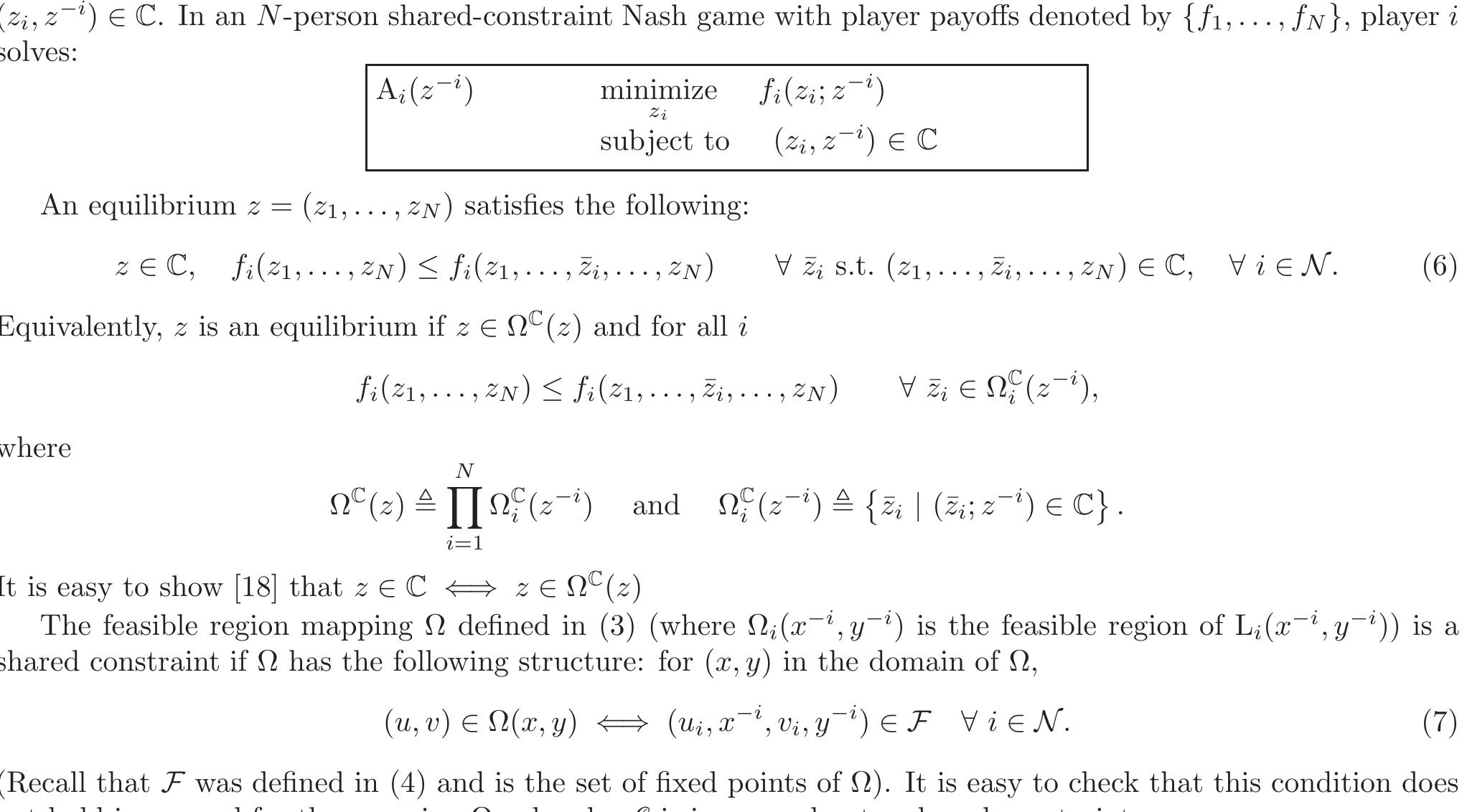


![A special case of the conventional game & which is already a shared-constraint game is the case (denoted by &>!) where leaders have disjoint set of followers. Effectively, each leader solves bilevel optimization problems a follows. Since y; € §; (2), there is no coupling of leader decisions in the constraints of leader problems. This is a special case of & with S(x) = []j< a Se (a;), where S; (x;) is the solution of a variational inequality for each 7 and where the objective of leader i depends only on the equilibrium of S; (xi) and not on S; (x;) for 7 £ 7. With a slight abuse of our notation so far, we let y; denote an element of the set S. (x;) and Y; be the apaiae of such y;. Let OF be the feasible region of L?!(a~*, y~*) and let F°! be the set of fixed points of >! + mW, QP. Since there is no coupling, it is easily seen that](https://figures.academia-assets.com/118245873/table_007.jpg)


![Verifying Proposition 3.1 (An equilibria of & is an equilibrium of &*°): Let us now consider this game modified as €°°. Notice that the equilibrium constraint is now for all f and for all k. For any k, the equilibrium constraint may be simplified using (24), giving an equation in Y,. It is easy to check that this game also admits no equilibrium with >?,2; > a/b. Thus, this game is equivalent to the game where >’, 2; is constrained to be in [0,a/b]. For such values of )7, 7;, the first case of (24) applies, and it gives us a game where leader i solves](https://figures.academia-assets.com/118245873/table_010.jpg)
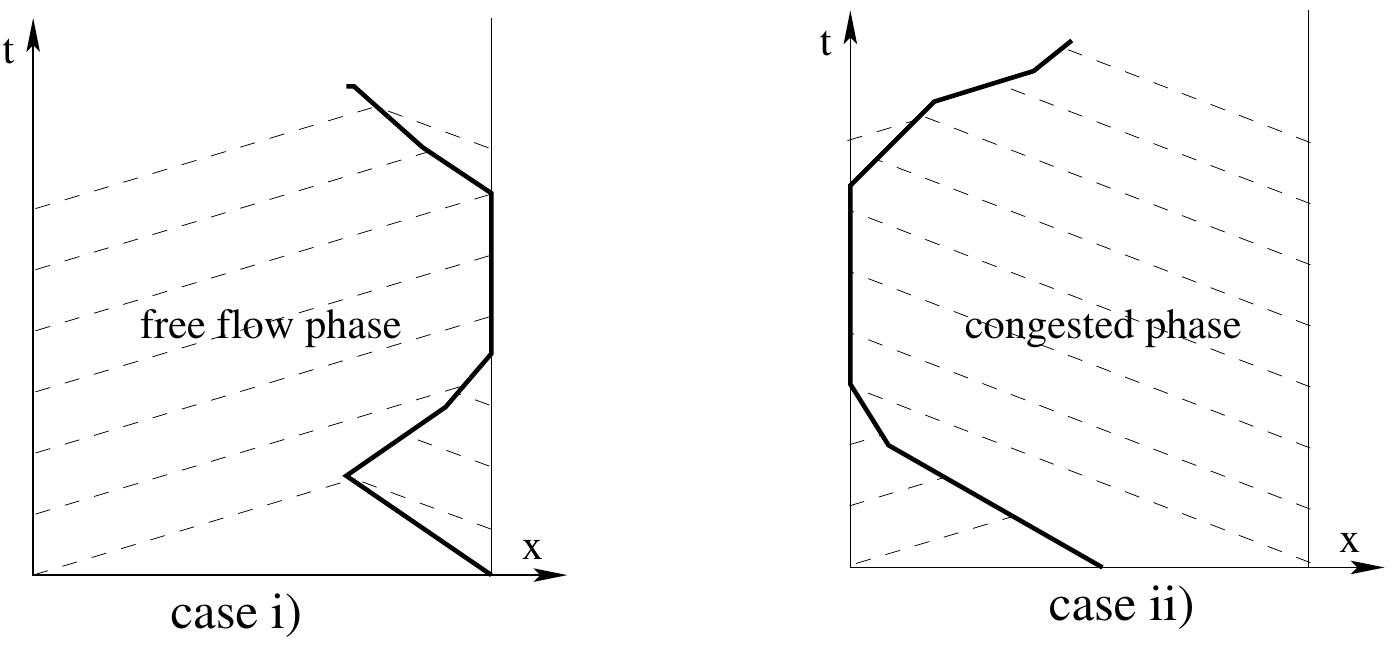
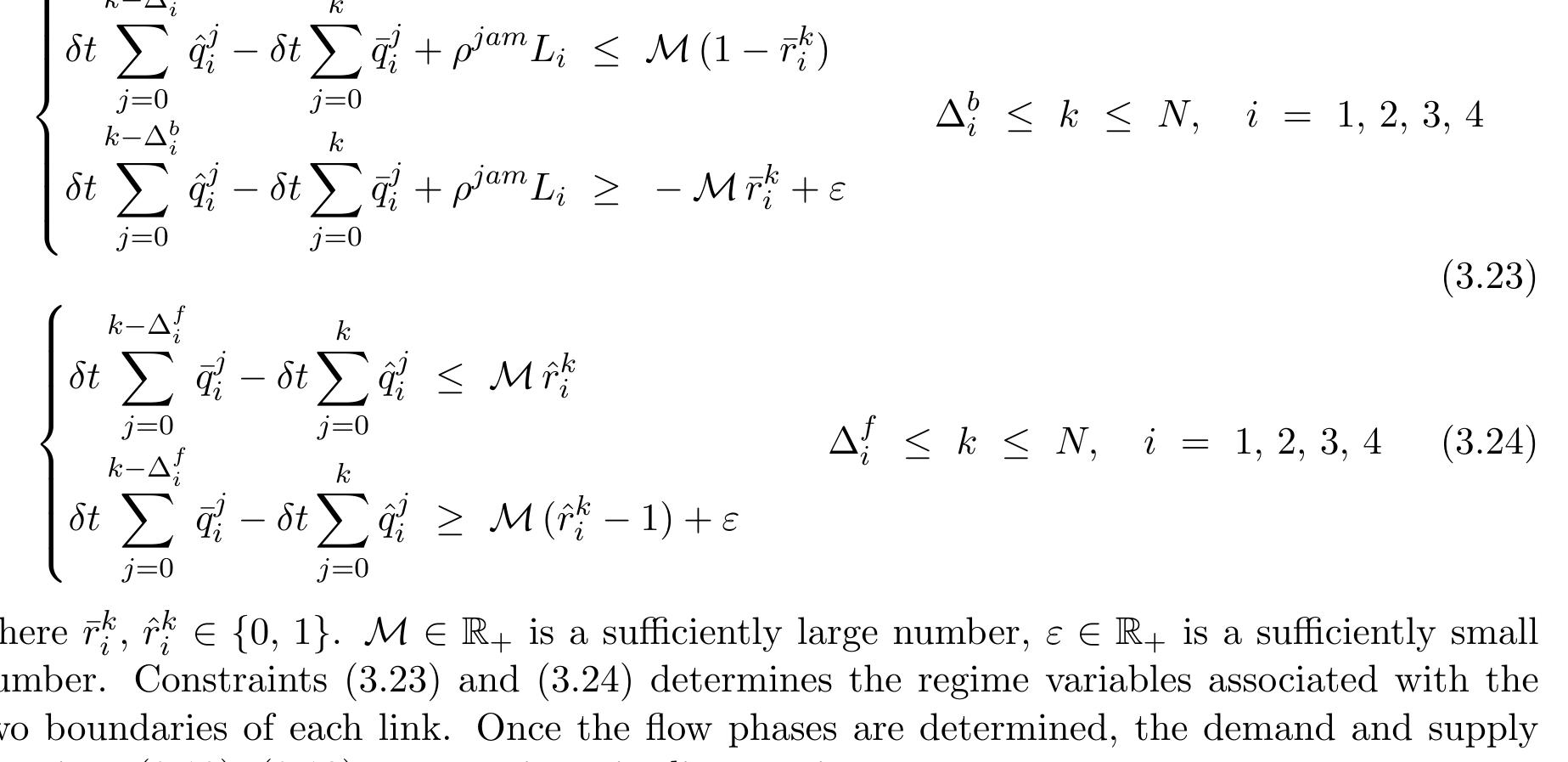
![Figure 2: A signalized junction with two incoming links and two outgoing links. In this section, the signal control problem is formulated with LKWM. We start with a single junction, with two incoming links 1, 2, and two outgoing links J3, I, (Figure 2). Each link is represented by a spatial interval [a;, b;], i = 1, 2, 3, 4. The fundamental diagrams for each Traffic signal control problem based on the LK WM](https://figures.academia-assets.com/110785962/figure_002.jpg)




![Fig. 1. Idealized moment-rotation law. Kaneko formulation [5] The M-R laws for n-critical sections are presented in the following set of equations](https://figures.academia-assets.com/107790346/figure_001.jpg)


![The new algorithm incorporates a test for identify- ing the occurrence of a plastic collapse mechanism. Such collapse is possible when the slope of the third segment of the M-R law is horizontal and occurs when a sufficient number of plastic hinges are formed to transform the structure into a mechanism before the limiting rotation is reached at any critical section. Computationally, this is detected when submatrix Ze, becomes singular [7] (see step 1 below).](https://figures.academia-assets.com/107790346/figure_004.jpg)