







The trouble is that thought and culture are not the sort of thing that can have distinct units. They do not have a granular structure for the same reason that ocean currents do not have one — namely, because they are not stuffs, but patterns.
— Mary Midgley, Myths We Live By
.   ∧_∧
  ry´・ω・`ヽっ
  `!     i
   ゝc_c_,.ノ
    (
    )
 .∧_∧.(
(´・ω・ ∩
o   ,ノ
O_ .ノ
 .(ノ
My name is Gwyneth Windflower, but everybody calls me Winnie (or Gwen if I'm in trouble, or 'Aunt Gen' if you're my niece)
💽🌿 I do a lot of different stuff, my friend! The unifying theme is helping humans use our most recently evolved sensory tool — data — in ways that are both more effective and intuitive. So, while I hate to be overly cute about things (not true, like extremely not true), instead of staying cramped in the box of analyst or engineer (or developer experience advocate, teacher, consultant, manager...), sometimes I prefer to just say that I’m a Data Cowgirl. I ride around my trusty stallion Bracket and make sure all the data is1 thriving. Nurture it, help it grow strong, and when the leaves turn I go shear it and spend the long winter weaving it into tapestries. How exactly that manifests changes all the time — teaching workshops, handcrafted dev tools, bomb-proof streaming data platforms for industrial manufacturing, cookbook repos, partnering with Sales on a Hex app to smash their Q4 goals, building community in-person and online (and a dozen other things) — but the motivation remains the same: nurture an organization's data ecosystem, get people excited about their ability to do amazing things within it, then work together to understand this world a little better every day.
🍊⚙️ Most recently, I spent a few years working in Developer Experience at dbt Labs, and before that a couple years in their consulting wing. I started back when it was a scrappy 20 person consulting firm called Fishtown Analytics that had accidentally built something magical. What I cherish most about my time at dbt was working across a huge variety of organizations — so many different challenges, so many different needs, and I got to touch every tool, every platform as I built solutions. This really sharpened my approach, honing down to what actually matters, what transcends the ever-changing river of tools and code. I learned to find the most important questions and build better answers, not data platforms. And I learned to build excellent things very quickly.
🏎️✨ Most importantly though, all the amazing teams I got to work with showed me that prioritizing people — becoming a passionate teacher, solidfying trust through deep listening and empathy (taking the time to do the work that you're aiming to improve alongside the stakeholders is invaluable), nurturing curiosity and ownership in every person, every role —is orders of magnitude more powerful than any technology2. Data teams should think of themselves as a Platform team for the rest of the business — clarity, velocity, solid answers, better decisions — not a help desk where hard questions get answered with a list of caveats longer than the notebook code.
🔧🤠 Working in DX was particularly special, as our team not only handled typical work like creating resources and expanding the community, but also building tools and pushing commits to the product directly when possible. This kind of 'Full-stack DX' created a deep, mutually beneficial symbiosis between dbt Labs and the dbt community that helped both thrive and stay true to our mission. Every member of that team was so sharp and special, it was quite a squad!
👩🏻🌾🌱 Terminals, shells, command lines, Neovim, and spending waaay too much time gardening my dotfiles. You can check them out here. I'm excited by the terminal renaissance we're seeing because of Claude Code, even though it's totally transforming the work. The speed you can move at, the toil you can avoid, it's incredible.
🎷🦕 To that end, writing cute and useful CLI tools in Go with the Charm libraries lately. It makes me very very happy.
- DuckDB
- Cool stuff with Arrow Flight like the Airport extension
- Daft
- DataFusion (and the convergence on A4 - All Apache Arrow Always)
- Marimo
-
Data visualization is overrated! Don't get me wrong, I love visuals, and there are many, many analyses where they help communicate in a way words can't (I'm a girl with the complete works of Tufte on my shelf) — but in BI, visualization is treated as the go-to, the standard, THE final destination of all this engineering and modeling effort. It's past time we remembered that this week's revenue numbers might work better in a short paragraph, and thankfully LLMs are getting us there.
-
You're looking at too much data. Your brain cannot track 50 metrics hour-by-hour, day-by-day in a way that is useful and effective. Most people try to do this becaue they're afraid of being asked a question about their domain they can't answer, and the anxious need to watch all these numbers makes them less sensitive to the signal, not more. It's theater. Instead, focus on a handful of metrics and your theories of their growth levers, do that consistently over a sustained period of time until you've established confidence in the right levers. Stay disciplined! Push on them, measure what happens. Map out the machine, and set up thresholds to alert you when the machine inevitably starts to change. Rinse. Repeat.
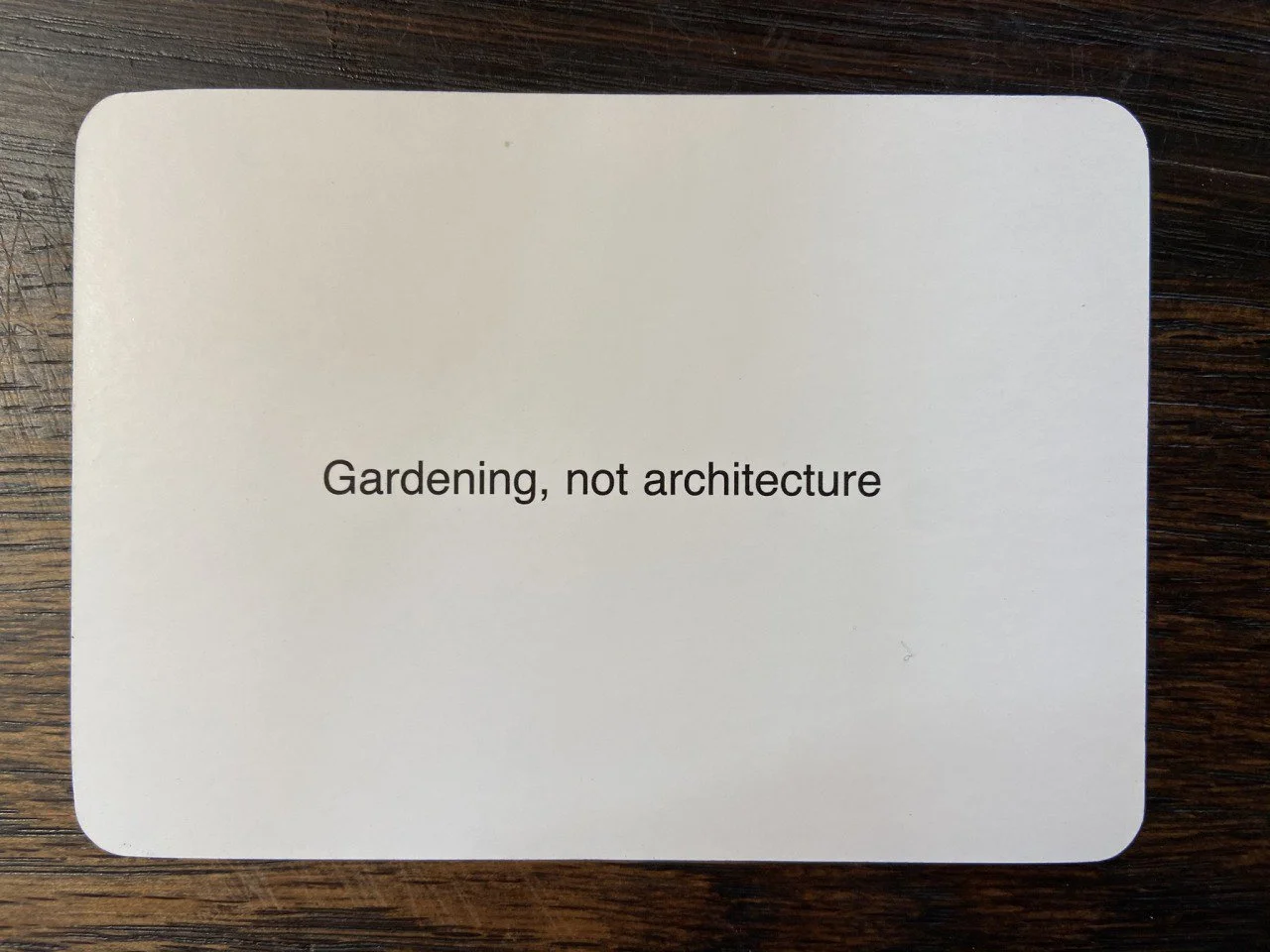
🃏🧚🏼 I'll leave you with something relevant to ponder — my favorite card from Brian Eno's famous Oblique Strategies deck...
𝒯𝒽𝒶𝓃𝓀𝓈 𝒻ℴ𝓇 𝓈𝓉ℴ𝓅𝓅𝒾𝓃ℊ 𝒷𝓎! ˚ʚ♡ɞ˚
⠀⠀⠀⠀⠀⠀⠀⠀⠀⠀⠀⠀⠀⠀⢀⡴⠒⠦⣄⣠⠶⠞⠳⣆⠀⠀⠀⠀
⠀⠀⠀⣴⠛⠛⠛⠲⢦⣤⡴⠶⠶⢶⠏⠀⢀⣄⣹⣇⡀⠀⠀⣻⡀⠀⠀⠀
⠀⠀⠀⡿⠀⠀⠀⠀⠀⠀⠀⠀⠀⢸⠂⠀⢿⣼⠋⠀⠉⣿⣍⠉⠉⡆⠀⠀
⠀⠀⠀⢿⡤⠀⠀⠀⠀⠀⠀⠀⠀⠈⠧⠤⠤⠿⢦⣀⣤⠿⠼⠀⣰⠃⠀⠀
⠀⠀⠀⡾⠁⠀⠀⠀⠀⠀⠀⠀⠀⠀⠀⠀⠀⠀⠀⠀⠈⠳⠤⠶⢿⡀⠀⠀
⠀⠀⢸⡇⠀⠀⠀⠀⠀⠀⠀⠀⠀⠀⠀⠀⠀⠀⠀⠀⠀⠀⠀⣠⣼⡧⠤⠆
⣠⣤⢼⡧⢤⠀⠀⠀⢠⣦⠀⠀⠀⠀⠀⠀⠀⠀⠀⣾⡇⠀⠀⠀⣤⣧⣄⡀
⠀⠀⢀⡿⠉⠹⡄⠀⠈⠋⠀⠀⠀⣴⠒⡆⠀⠀⠀⠀⠀⠀⠀⣀⣼⠁⠀⠀
⢠⡞⠉⠛⠀⠀⠹⠶⠶⣄⠀⠀⠀⠈⠉⠀⠀⠀⠀⠀⠀⠀⣀⠾⠉⠙⠒⠀
⠀⠳⢤⣀⠀⠀⢠⠖⠒⠈⢳⣀⠀⠀⢀⣀⣀⣀⣤⠤⠖⠛⠁⠀⠀⠀⠀⠀
⠀⠀⠀⢹⡀⠀⠘⠲⠖⠃⣼⠋⠉⠁⠉⠈⠀⠀⠀⠀⠀⠀⠀⠀⠀⠀⠀⠀
⠀⠀⠀⠀⠛⠦⣤⣤⠴⠞⠁⠀⠀⠀